


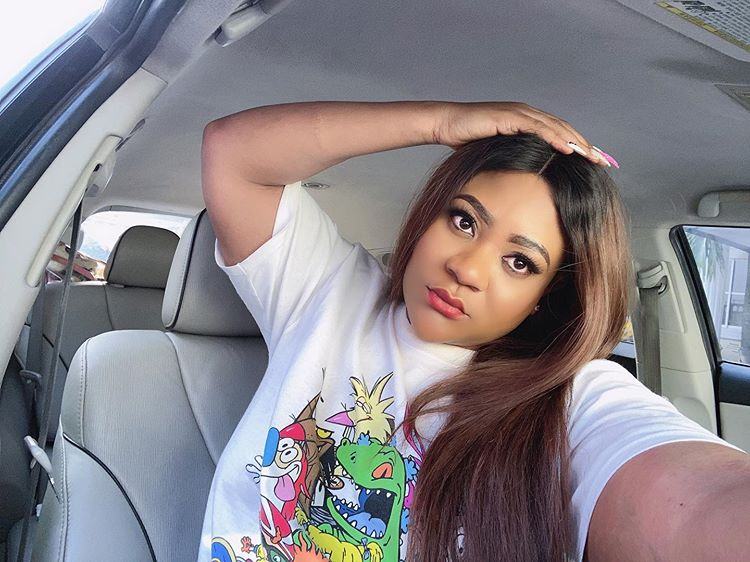
Nollywood star Nkechi Blessing has warned women against marrying men they financially support. She recently had her say via her Instagram page, and fans have been reacting.
Reacting to Uche Ogbodo announcing her separation from her husband, Nkechi stated that marriages where the woman is the one feeding the man are unlikely to last.
The moviestar added that marrying a lazy man is bad enough, being with a proud lazy man is even worse.
Her words, “Never think marrying a man you are clearly feeding will last. No matter how much you tend to cover it up, e no go ever end well. If you jam the one wey lazy still get dirty-smelling pride join? Your own don finish.”
Nollywood is a sobriquet that originally referred to the Nigerian film industry. The origin of the term dates back to the early 2000s, traced to an article in The New York Times. Due to the history of evolving meanings and contexts, there is no clear or agreed-upon definition for the term, which has made it a subject to several controversies.
The origin of the term “Nollywood” remains unclear; Jonathan Haynes traced the earliest usage of the word to a 2002 article by Matt Steinglass in the New York Times, where it was used to describe Nigerian cinema.
Charles Igwe noted that Norimitsu Onishi also used the name in a September 2002 article he wrote for the New York Times. The term continues to be used in the media to refer to the Nigerian film industry, with its definition later assumed to be a portmanteau of the words “Nigeria” and “Hollywood”, the American major film hub.
Film-making in Nigeria is divided largely along regional, and marginally ethnic and religious lines. Thus, there are distinct film industries – each seeking to portray the concern of the particular section and ethnicity it represents. However, there is the English-language film industry which is a melting pot for filmmaking and filmmakers from most of the regional industries.

Visit NaijaVibe HoT 100 Songs