

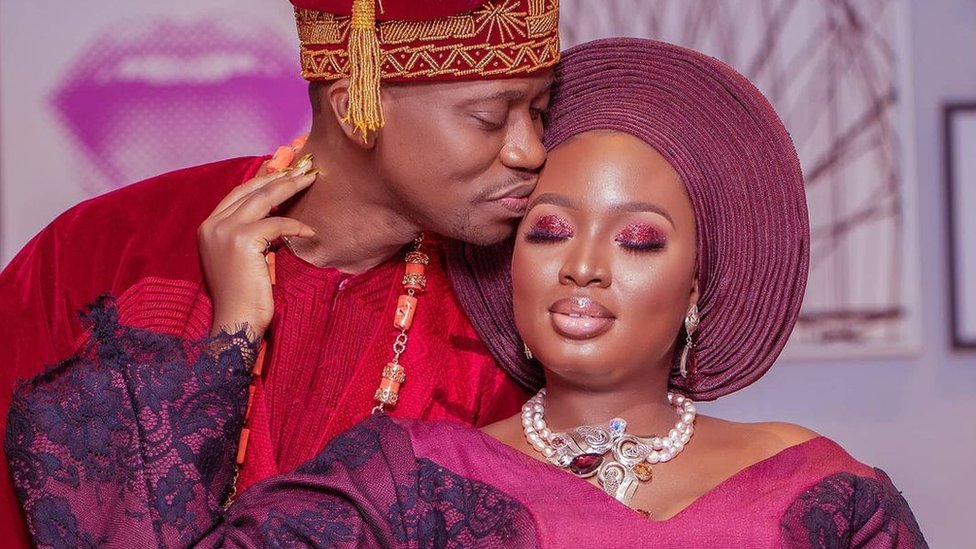
Nollywood actress Mo Bimpe has responded to public reactions over a viral video of her interacting with actor Jide Awobona at a party. She recently had her say via her Instagram story, and fans have been reacting.
Describing her conversation with Awobona as a normal discussion between friends, Mo Bimpe stressed that her marriage is built on trust, not insecurity.
She added that her husband is a secure man who will not be threatened by a harmless convo.
Her words, “A one-minute clip of myself & Jide has somehow become a topic of public analysis.
It’s fascinating how a normal conversation between friends has become suspicious to some of you.
Not every marriage is built on fear, insecurity, and constant monitoring. Some marriages are built on trust, friendship, respect, and confidence. The fact that so many of you found that interaction strange says more about the relationships you’re used to than it does about mine.
Not every marriage is toxic; there are still healthy marriages, but I understand if you can’t relate. My husband is a secure man; a brief conversation with a family friend does not threaten our marriage or warrant anyone’s concern. Love and light.”
Nollywood is a sobriquet that originally referred to the Nigerian film industry. The origin of the term dates back to the early 2000s, traced to an article in The New York Times. Due to the history of evolving meanings and contexts, there is no clear or agreed-upon definition for the term, which has made it a subject to several controversies.
The origin of the term “Nollywood” remains unclear; Jonathan Haynes traced the earliest usage of the word to a 2002 article by Matt Steinglass in the New York Times, where it was used to describe Nigerian cinema.
Charles Igwe noted that Norimitsu Onishi also used the name in a September 2002 article he wrote for the New York Times. The term continues to be used in the media to refer to the Nigerian film industry, with its definition later assumed to be a portmanteau of the words “Nigeria” and “Hollywood”, the American major film hub.
Film-making in Nigeria is divided largely along regional, and marginally ethnic and religious lines. Thus, there are distinct film industries – each seeking to portray the concern of the particular section and ethnicity it represents. However, there is the English-language film industry which is a melting pot for filmmaking and filmmakers from most of the regional industries.

Visit NaijaVibe HoT 100 Songs